Showing posts with label CFA. Show all posts

Saturday, September 16, 2017

CFA Level 1 Time Value of Money LO c: Impact of frequency of compounding on EAR

Hello and welcome back. 

In the previous blog we talked about the components of an interest rate. If you haven’t read the previous blog, please see it first.

In this blog, we will talk about the impact of frequency of compounding on effective annual rate (EAR). Compound interest, as you should know by now, is the interest on interest, i.e. the money that we earn on our interest from the previous period.


Let’s take a simple example. 

Example 1)

Suppose you have a 1000$ and you want to invest it for 2 years. You have 2 options:

1.) You can invest it on Simple Interest, i.e. you earn fixed interest every period. Let’s say the rate of interest is 10%. So, the Simple interest for one year will be 10% of 1000$, i.e. 100$. So, over 2 years you will earn a total of 200$.

2.) You can invest it on Compound Interest, i.e. you earn progressively increasing interest as you earn interest on interest. Let’s say the interest is compounded annually.

So, after 1 year, you earn 100$ on your investment.

Now, at the end of 1 year, your new Principal is 1100$. So, at the end of 2nd year you earn 100$ on your initial investment and 10$ (10% of 100$) on the interest you earned after first year. So, after 2 years, you earn a total of 210$.

Let’s see this again.

We know that FV = PV(1 + I/Y)where

• PV is used for Present value or Current Value or Value at time 0
• FV is used for Future value or Value at time t
• N signifies Number of compounding periods
• I/Y is used for Interest rate per compounding period

So, at the end of 1st year, FV=1000(1.1)1 = 1000*1.1 = 1100
At the end of 2nd year, FV=1000(1.1)2 = 1000*1.21 = 1210

You need to get comfortable doing these calculations and you should be able to do these on BA II plus calculator.

PV= -1000 (negative as this is a cash outflow, you are investing money)
I/Y= 10 (rate of interest per compounding period, you do not need to change it to decimal)
N = 2 (number of compounding periods)
PMT = 0 (Regular payments, not present in this case)
CPT à FV  to get the answer $1210.

Now, let’s take another example:-

Example 2)     

Let’s say you have $1000 and you can invest it on either simple interest or compound interest (compounded annually) for 20 years. The rate of interest is 10%. What will be the value of your investment after 20 years?

Again, for SI: Interest per year = 1000 * 0.1 = $100
In 20 years, we will earn $100 * 20 = $2000
Total Amount after 20 years = $1000 (Principal) + $2000 = $3000

For Compound Interest PV= -1000, N=20, I/Y=10, PMT=0 CPTàFV to get $6727.5


So, as you can see, by investing on Compound Interest, you receive more than twice of what you would have received at Simple Interest. This is the Power of Compounding.

Example 3)

Let’s say you have 1000$ to invest for 2 years. The frequency of compounding is semi-annually. What is the value of the investment after 2 years?

In this case, PV = -1000,
I/Y = 5 (Remember, we are compounding semi-annually, so the interest rate we will use will be half of stated annual interest rate)
N = 4 (Again, number of compounding periods will be 4 in 2 years as we are compounding semi-annually)
PMT = 0
CPT à FV to get the answer $1215.51

So, as you can see, we are earning more money than when we were compounding annually.

What happens if we start compounding quarterly?
PV = -1000
I/Y = 2.5 (As now we have 4 quarters per year)
N = 8 (We have 8 quarters in 2 years)
PMT = 0
CPT à FV to get the answer $1218.40

Let’s go a bit further. What if we start compounding monthly?
PV = -1000
I/Y = 0.833 (As now we have 12 months per year)
N = 24 (We have 24 months in 2 years)
PMT = 0
CPT à FV to get the answer $1220.38

Few points to note:-
1.) Both Compound Interest and Simple Interest values are exactly the same after the end of 1st compounding period. This is because you have not started earning interest on interest.
2.) Higher the frequency of compounding, greater is the amount of interest earned.
3.) Compound interest effects are pronounced when the interest rates are high and the duration of investment is long.

Now we can start talking about Effective Annual rate. 

Traditionally, all interest rates are quoted as annual interest rates and the frequency of compounding is mentioned.

For example, you will see interest rate mentioned as 10% compounded quarterly, rather than 2.5% per quarter.

So, in reality an investor will receive a different interest rate because of the effects of compounding. This actual interest rate received by an investor is called Effective Annual Rate (EAR).

Let’s look at an example.

Example 4)
Let’s say you want to invest 100$ at 10% interest rate compounded annually.
So, you will receive 1.1*100 = 110$ at the end of 1st year.

What if the frequency of compounding was semi-annually?
PV = -100, N =2, I/Y=5, PMT=0, CPTàFV to get $110.25
So, the effective annual rate in this case is 10.25%

What if the frequency of compounding was quarterly?
PV = -100, N =4, I/Y=2.5, PMT=0, CPTàFV to get $110.38
So, the effective annual rate in this case is 10.38%

In general, you can calculate Effective Annual Rate using this formula:-


So, for our previous example:-
EAR Semi Annual Compounding = (1 + .05) 2 – 1 = 0.1025 = 10.25%
EAR Quarterly Compounding = (1 + .025) 4 – 1 = 0.1038 = 10.38%

As you must have realized by now, Stated Annual Interest Rate and EAR will be equal if and only if interest is being compounded annually. In all other cases, EAR will be higher than Stated Annual Interest rate and the difference between these two will increase with the increase in frequency of compounding.

Finally, let’s talk about the extreme case of continuous compounding. In case of continuous compounding,


So, if r = 10%
EAR Continuous Compounding = e 0.1 – 1 = 1.105171- 1= .105171 = 10.51%

Before we end this topic, let’s see a couple of examples:-

Example 5)
You are an investor who has been provided with two similar investment options with the same risk level. The 1st investment option is offering you 10.4 % interest rate compounded semi-annually, while the 2nd investment is offering you 10% interest rate compounded monthly. Which is a better investment option, considering all other factors are same for these two investments?

To solve these problems, it is imperative that we convert all the interest rates to EARs so that we can do a proper comparison.

In our current example,
For Semi-Annual compounding, EAR = (1 + 0.104/2)2 – 1
                                                              = (1.052)2 – 1
                                                              = 1.106704 – 1 = 0.106704 = 10.67%

For monthly compounding, EAR  = (1 + 0.10/12)12 – 1
   = (1.008333)12 – 1
                                                       = 1.104709 – 1 = 0.104709 = 10.47%
As we can see, the 1st investment option with Semi-Annual compounding is better in this case.

Example 6)
You are told that the EAR for an investment is 12.55% with quarterly compounding. Find the periodic rate for this investment.

We know that EAR =   (1 + Periodic Rate) m -1
0.1255 =  (1 + Periodic Rate) 4 – 1
1.1255 =  (1 + Periodic Rate) 4  
   (1.1255)1/4  =  (1 + Periodic Rate)
           1.0299 =  (1 + Periodic Rate)
Periodic Rate = .0299 = .03 = 3%

By now you should be comfortable handling Effective Annual Rates, Stated Annual Rate and Periodic Rates. 

You can watch a video explaining the points discussed in this blog here:-


This brings us to the end of learning outcome c for this reading. In the next blog, we will talk about learning outcome d: Solving TVM problems for different frequencies of compounding.

For more CFA tips watch the posts in this blog. You will also find a number of CFA topics discussed on this blog in simple terms. You can also subscribe to our YouTube Channel on this link.


Thursday, September 14, 2017

CFA Level 1 Time Value of Money LO b: Various Components of Interest Rate


Hello and welcome back. 

In the previous blog, we talked about the 3 ways in which Interest rates can be interpreted which was the first learning outcome for this reading. If you haven’t read the previous blog, please read it first.

In this blog, we will talk about the various components of interest rate. Let’s take an example, suppose you have 1000$ to invest and you have two options: the first one is to invest it in U.S. Treasury bills or T-bills, the 2nd option is to loan it to an entrepreneur who is starting a new venture. Do you expect both these investment options to have the same rate of return?

Of course not as these two investment options have different “risks” associated with them. And any sensible investor would want a higher return for a riskier investment. So, it’s clear that interest rate varies.

Now, let’s look at the various components of an interest rate:-


Let’s try and understand each of these components.

1. Real risk-free rate: The real risk-free rate is a theoretical rate that a completely risk-free investment would provide in a single period, if there was no inflation. So, the real risk-free rate basically provides the rates at which a completely risk-free investment would grow in a period, if there was no inflation.

The closest real world example to this would be U.S. Treasury bills or T-bills, if we could remove the component of interest rate that compensates for inflation (or the inflation premium, which is discussed next).

2. Inflation Premium: The inflation premium is the premium for expected inflation over the duration of the investment. The key word here is expected. Obviously, the inflation is not zero; you do expect the cost of most things to go up with time and you don’t want your purchasing power to decrease over the period of investment. The inflation premium is supposed to ensure that your purchasing power stays the same. Now, we cannot predict the actual inflation, so expected inflation premium is used.

Next, let’s talk about the Nominal risk-free interest rate. While the real risk-free rate is a theoretical concept, nominal risk-free rate (which is the sum of real risk-free rate and inflation premium) is a real concept. U.S. Treasury bills or T-bills are considered to be representative of Nominal risk-free rate.


This is why when we discussed Real risk-free interest rate, we mentioned that if you could take out the inflation component from U.S. Treasury bills, you would get the real risk-free interest rate.

Please note that the above relation is an approximate relation. The actual relation is:-


3. Default Risk Premium: As we were discussing before, you don’t expect an investment with an entrepreneur to have the same level of risk as U.S Treasury bill. There is a possibility that the entrepreneur may not be able to return you the promised amount of money at the agreed upon time. There is a risk that the business might not do as well as expected or worse, it completely fails and you do not get your money back. This is a risk that you are taking when investing money with the entrepreneur and you would want a premium, an interest rate differential for taking this risk. This premium is called the Default Risk Premium.

As you can expect, this risk will vary by the investment (riskiness of the project) as well as the credit worthiness of the borrower.

4. Liquidity Premium: Liquidity premium compensates for the potential risk of losing money if the investor needs to get cash urgently. So, if there are a lot of investors and buyers for a specific investment, the liquidity premium will be low. However, if not a lot of investors and buyers are interested in a specific investment, the liquidity premium will be high.

Suppose you need cash urgently and you have invested your 1000$ in U.S. Treasury Bills, you can easily sell these. However, if you are trying to sell your position with the entrepreneur chances are that you won’t have the same number of interested investors. There is a possibility that you won’t be able to sell your position in the entrepreneur’s business at a fair value. The liquidity premium is supposed to offset not only the cost associated with selling an investment, but also the loss because of not receiving a fair price.

5. Maturity Premium: Maturity premium compensates for the potential of interest rates to change during the life of an investment. Let’s say you have decided to invest your 1000$ in a particular investment and the only decision you have to make is if you want to invest for 1 year or 5 years. Will you expect to get the same interest rate?

Of course not!

When you invest money for 5 years at a fixed rate, you cannot change the interest rate for 5 years! What if the market rate for the investment goes up in this time period? Even if your interest rate is tied to a reference rate like LIBOR (i.e. you are earning a certain % more than the prevailing LIBOR per period), you still cannot change the spread (i.e. the percent above LIBOR you are earning).

For example, let’s say you have made an investment in a security at LIBOR+ 1%. This means you will be earning 1% higher than the LIBOR every period. So, if the LIBOR rises up, your earnings increase and vice versa. However, as you have fixed your spread at 1% above the LIBOR, your earnings will always be 1% more than LIBOR. As a result, you won’t be able to change the interest rate even if the existing market rate for that security goes up.

Maturity premium compensates for these uncertainties over the investment horizon. 

You can watch a video explaining the points discussed in this blog here:-


This brings us to the end of learning outcome b for this reading. In the next blog, we will talk about learning outcome c: How to calculate effective annual rate.

For more CFA tips watch the posts in this blog. You will also find a number of CFA topics discussed on this blog in simple terms. You can also subscribe to our YouTube Channel on this link.


Monday, September 11, 2017

CFA Level 1 Time Value of Money LO a: Various Interpretation of Interest Rates

Hello and welcome back. 

In this blog, we will start talking about Time Value of Money, which is the first reading of Quantitative methods Study Session for the CFA Level 1 exam. The concepts discussed in this reading are not only important for the CFA exam but as a finance professional, you will be using these tools regularly.

I hope you have seen our previous blogs 0C. Introduction to Time Value of Money (TVM) Calculations for CFA Level 1 (with Examples) and 0D. Introduction to Cash Flow (CF) Calculations for CFA Level 1 (with Examples). If you haven’t done so, I will strongly advise that you read these 2 blogs first and get familiar with basic concepts before we move ahead in this study session. 

So, let’s start talking about Time Value of Money. What exactly is the meaning of Time Value of money? 

Let’s say I offer you a 1000$ and I give you two options: you could either have it today or you could have it after a year. 

Which option would you choose?

Of course Option 1, right! 

This is because you know that you could either invest those 1000$ today to get a higher amount of money after a year or you could buy/spend that 1000$ to buy something that may be more expensive in future. So, as you can see a 1000$ today is much more valuable than a 1000$ one year from now, i.e. money has a time value: the sooner we get, the more valuable it is.

Now let’s talk about the first Learning Outcome which states “Interpret interest rates as required rates of return, discount rates, or opportunity costs”. Interest rate signifies how quickly your money grows (if you are an investor). In simple terms, a higher interest rate implies a quicker growth of your money. Now interest rates can be interpreted in a number of ways and CFA curriculum requires you to understand these 3 interpretations:-

1. Required rates of return: Every investor needs some “financial motivation” to invest his money. The required rate of return is the interest rate that an investor requires to loan/invest his money for a particular investment (considering the “risk” involved in investing). 

Let’s say I have a 1000$ and you want to borrow it from me for a year. Now, I need to have some financial motivation to give my money to you. Let’s say I want at least 1100$ after a year to give my money to you. Now, this additional 100$ is my financial motivation to loan the money to you. In simple terms, I am making 100$ on my investment of 1000$ in a year. So, my rate of return is 10%. 

The required rate of return is the minimum interest rate that will convince an investor to invest his money for any particular investment. As can be expected, the required rate of return will vary for different investments.

2. Discount rates:  Interest rates can also be called discount rates as the future payments are “discounted” at this rate to arrive at the present value of the future payments. 

For our previous example, the discount rate is 10% as the future payment of 1100$ at the end of one year, when discounted at 10% yields 1000$ today. 

Required rate of return and discount rate are terms that are used interchangeably, they imply the same interest rate.

3. Opportunity costs: Opportunity cost is the cost of spending the money now, rather than investing. This is the lost value that the money could have earned if it was invested rather than spending it today and is given in terms of the interest rate as well. 

For our previous example, the opportunity cost of current consumption will be 10% as the investor would lose the benefit of earning 10% if he spends the money today.


Please note that all these 3 terms represent interest rate, but they explain interest rate from different perspective. Required rate of return is the interest rate from an investor’s perspective, discount rate is the interest rate from a borrower’s perspective and opportunity cost is the interest rate from a consumer’s perspective.

You can watch a video explaining the points discussed in this blog here:-


In the next blog, we will talk about the 2nd learning outcome: various components of interest rate.

For more CFA tips watch the posts in this blog. You will also find a number of CFA topics discussed on this blog in simple terms. You can also subscribe to our YouTube Channel on this link 


Thursday, August 31, 2017

0D. Introduction to Cash Flow (CF) Calculations for CFA Level 1 (with Examples)

Introduction

Hello and welcome back!

In the previous blog, we gained some experience in solving basic TVM questions. If you want to revise your TVM concepts or if you haven’t read our previous TVM blog, you can watch this video:- 


In this blog, we will talk about the Cash flow calculations.

Cash flows can be even or uneven, that is you could be getting the same cash flow every period or different/irregular cash flows in different periods.


Even cash flows are solved similar to the basic TVM calculations. Let’s see an example:-

Example 1
Let’s say we want to find out the present value of an investment that pays 1000$ annually at the end of every year for next 3 years. The rate of interest is 10%.

Let’s draw a timeline:-


In this example, we have multiple cash flows, starting from the end of year 1. Please note that in these types of calculations end of a period is same as the beginning of the next period. For example, end of year 1 is same as the beginning of year 2.

Now,

For this example,
PMT=1000; FV=0 (as we want to find the Present value of the entire stream of payments); N=3; I/Y = 10 and we need to find out PV

So, we will enter FV=0, PMT=1000, N=3, I/Y=10, CPTàPV to get a value of -2486.85.


Remember, the positive or negative sign signifies if the cash flow is an inflow or outflow. In this example, if you made an initial investment of 2486.85$, you will get 1000$ every year for 3 years.

However, if you borrowed 2486.85$ today, you will have to pay 1000$ every year for 3 years.

If you have any issues solving this, watch this video:-


Example 2
Let’s say we want to find out the Future value of an investment that pays 1000$ annually at the end of every year for next 3 years. The rate of interest is 10%.

Let’s draw a timeline:-


Again, we have multiple even cash flows, starting from the end of year 1.

Now, for this example,

PMT=1000; PV=0 (as we want to find the Future value of the entire stream of payments); N=3; I/Y = 10 and we need to find out FV

So, we will enter PV=0, PMT=1000, N=3, I/Y=10, CPTàFV to get a value of - 3310$

If you are having issues with this, watch this video :-


Next, let’s talk about uneven cash flows.

Uneven cash flows can be handled by either handling each cash flow separately or by using the cash flow keys on the BA II plus calculator.

As we are handling variable cash flow amounts, don’t forget to draw a timeline to better visualize the inflow and outflow of money.

Also, remember to use different signs for inflow and outflow of cash. I recommend using positive sign for cash inflows and negative for cash outflows. If you follow a consistent sign system every time, chances of making a mistake are minimized.

Let’s look at some examples:-

Example 3
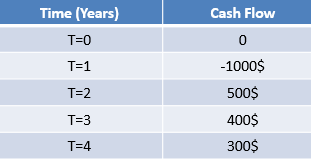
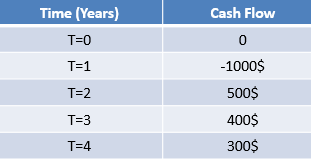
Let’s say we want to find out the present value of this stream of uneven cash flow. The rate of interest is 10%.


Let’s draw a timeline:-


Please observe a few things here: There is no cash inflow or outflow at the beginning of this project. After 1st year, there is a cash outflow of a 1000$, which in simple terms means that you are investing/spending a 1000$. After this the Project starts making money and you earn 500$ after year 2, 400$ after year 3 and 300$ after year 4.

We are assuming the rate of return as 10%.

To find the PV of this stream of cash flows, we will handle each cash flow separately.

So,

For CF1:  FV= -1000, I/Y=10, N=1, PMT=0, CPTàPV        PV= -909.09
For CF2:  FV= 500, I/Y=10, N=2, PMT=0, CPTàPV           PV=413.22
For CF3:  FV= 400, I/Y=10, N=3, PMT=0, CPTàPV           PV=300.53
For CF4:  FV= 300, I/Y=10, N=4, PMT=0, CPTàPV           PV=204.9

So, Total PV = -909.09+413.22+300.53+204.9= 9.56

As the Total PV is positive, this implies cash inflow is greater than cash outflow and this is a profitable investment.

Let’s watch this video:-


Example 4
Let’s say we want to find out the future value of this stream of uneven cash flow. The rate of interest is 10%.


Let’s draw a timeline:-


I am sure you have noticed that these cash flows are exactly the same as in Example 3. The only difference is that we are now going to find out the Future Value at the end of 4th year.

So,

For CF1:  PV= -1000, I/Y=10, N=3, PMT=0, CPTàFV        FV= -1331

N is 3 here as this cash flow occurs at end of year 1 and we need to find FV at the end of 4th year.

For CF2:  PV= 500, I/Y=10, N=2, PMT=0, CPTàFV           FV=605

For CF3:  PV= 400, I/Y=10, N=1, PMT=0, CPTàFV           FV=440

For CF4:  FV=PV=300 as this cash flow occurs at the end of the 4th year where we are finding the value.
          
So, Total FV = -1331+605+440+300 = 14

Again, as the total FV is positive, this implies cash inflow is greater than cash outflow and this is a profitable investment.

Remember, the decision about the profitability of any project should not be dependent upon the timing of analysis of cash flows, i.e. as long as you analyze all the cash flows at the same time period, you will get the same decision about the profitability of a project.

Is there another way we could have found the Future Value of this Project.

Indeed, if you remember FV = PV(1 + I/Y)N
So, here FV= 9.56(1+0.1)
= 9.56*1.14
=13.996796
=14

Which is same as the FV we calculated here.

The point to note here is that there will be multiple ways to find out the value of a stream of cash flows at any particular time.

Let’s watch this video:- 


Example 5
Now, we will solve example 3 again, but this time we will use the cash flow keys on the BA II plus calculator.


The uneven cash flow stream is shown in the picture below. The rate of interest is 10%. 


Let’s draw a timeline:- 


First of all, we need to clear the values stored in the Cash Flow keys (if any). To do this Press CF à 2ND àCE/C Key. As you should know by now, anytime we use the 2ND key, we activate the secondary functions of the keys in the BA II Plus calculator. So, when we press CFà2NDàCE/C keys, we activate the CLR WORK function which clears the cash flow registers.


It is important to note that before doing any TVM or Cash Flow calculations, we should clear the TVM register and the cash flow registers, respectively.

Now, let’s enter the cash flows.
CF0 = 0
C01 = -1000
C02 = 500
C03 = 400 and
C04 = 300
I/Y = 10
Finally Compute NPV to get 9.56.

I understand this might be new for some of you. Let’s watch this video to see how we can solve this question using a BA II Plus calculator.


I am sure you are now thinking if we can use the Cash Flow keys to get the Future Value of a series of uneven cash flows. Unfortunately, there is no key to do this. We need to find the Present Value and then utilize it to calculate Future Value.

So, for the previous example,

PV= 9.56, I/Y=10, N=4, PMT=0, CPTàFV        FV= -13.99 ≈ 14

This brings us to the end of this blog on Introduction to Cash Flow Calculations for CFA level 1 exam. As you can see, you can find out any missing information as long as we are provided with rest of the values.

You can watch a video explaining the points discussed in this blog here :-


The next step for you is to practice Cash Flow calculations as much as you can so that you can get comfortable with the ideas presented in this blog.

We will start discussing the Time of Value money Learning Outcome Statements (LOS) for CFA Level 1 in the next blog.

For more CFA tips watch the posts in this blog. You will also find a number of CFA topics discussed on this blog in simple terms. You can also subscribe to our YouTube Channel on this link